

 |
  |
Las Vegas, NV
At the end of 2002 the Penn & Teller show moved into Las Vegas in a more permanent fashion and as they started to curtail their constant touring Mr. Jillette began to reconsider some portions of the home we had designed for him, especially those which we had cut for budget considerations the first time around.
The first of these projects was a recording studio (ground floor) and sitting room (second floor). We already had a full band room connected to the home theater. The acoustics were so good in this space that one of the noted jazz bands in Las Vegas recorded their album there (“Four Nights at The Slammer,”). Mr. Jillette now wanted to have a proper mixing space. We had also made the master bedroom as small as possible; a decade later with the owner sleeping there every night, this made less sense. The new plan included a sitting room connected to the master bedroom.
There was a space for the complex addition between the master suite tower and the tower containing Mr. Jillette’s office. This was, in fact, a space that was purposefully designed void, a place where the tension between the two parts of the house were allowed to resolve in space rather than in a solid piece. Inserting a new volume was going to be challenging.
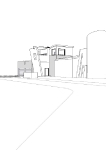
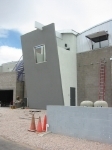
The project followed our usual process. We defined and refined the program of spaces so that we knew exactly what we were trying to fit into the space. The decision was made to allow the addition to project from the east fa�ade, and the east wall of it would tilt, in an inverse to the tilted wall of the kitchen. Because we would be filling in the entry to the courtyard, we would eventually need to develop a new entry to the house.
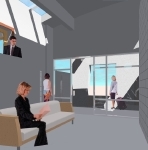
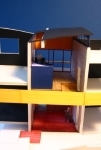
We created a scale model (one inch to four feet) to show the client. With the general idea accepted we moved to much more detailed drawings and renderings. The renderings meant that we were able to test out views from the entry to the new sitting room, which were then approved by the client.
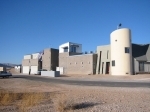
The new two story structure is a manipulation of the existing geometries (a series of slight rotations in plan), and a tight essay of exterior space relating to interior space. The resulting tension of definition and envelope is expressed with storefront stretched between the exposed concrete block wall and a wall that continues out the terrace.
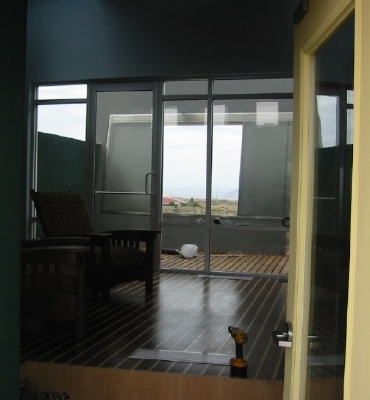
Our intention to create a continuous space from interior to exterior was realized with a walnut floor with narrow strips of maple. These lines transform at the glass wall where the thin pieces of maple match the space between the teak planks; the dark and light patterns reverse.
A strip of glass over the entry to Mr. Jillette’s office means that his office retains the island-like isolation that he appreciated in the original plan. The natural light still falls through the glass panel in the door which is reached by walking up a half flight of stairs from the sitting room. These stairs are curved, and are hidden behind a low wall, further increasing the privacy and separate quality to his office.
The studio addition started construction in October 2003 and was completed in June 2004. Crisci Custom Builders was the contractor.
 |
 |
 |
| Click on an image to go to the gallery. | ||